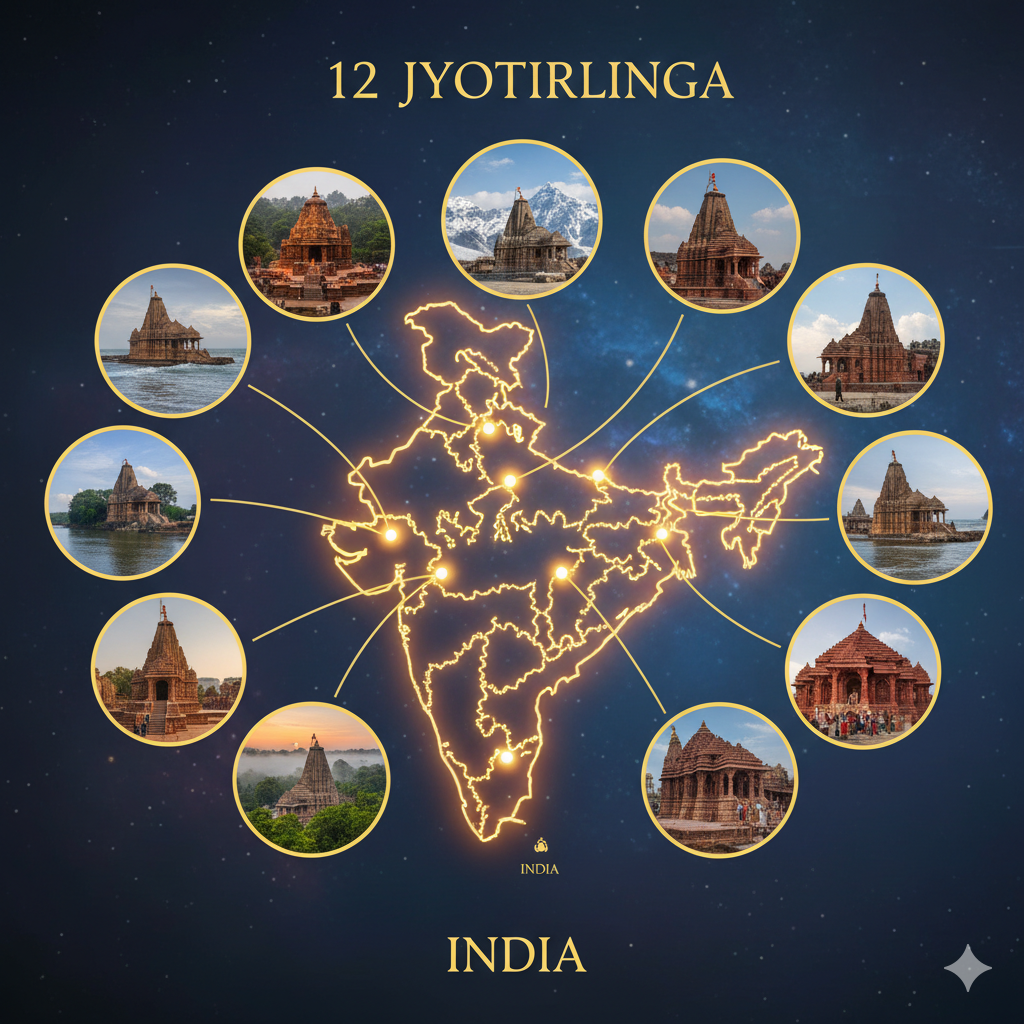
For us, a journey transcends mere sightseeing—it’s about the stories that unfold, the spiritual connections we forge, and the divine experiences that transform our souls. When it comes to spiritual pilgrimages in India, few journeys match the profound significance of visiting the 12 Jyotirlinga in India. These sacred shrines, scattered across our diverse nation, represent the holiest abodes of Lord Shiva and stand as timeless testaments to unwavering faith and deep-rooted cultural heritage.
The 12 Jyotirlinga in India aren’t merely temples carved from stone and devotion; they are manifestations of divine light, spiritual beacons that have guided countless devotees for centuries. Each Jyotirlinga tells a unique story, represents a distinct aspect of Lord Shiva’s infinite nature, and draws millions of pilgrims seeking spiritual liberation, inner peace, and divine blessings.
The Spiritual Tourism Revolution in India
Religious tourism in India has witnessed unprecedented growth, emerging as one of the fastest-growing segments in our travel industry. The numbers tell a compelling story: religious tourism in India rose to 1,439 million visitors in 2022 from 677 million in 2021, with revenues reaching USD 16.2 billion. More recently, pilgrimage tourism witnessed a remarkable 19% year-on-year growth in FY 2024-25, reflecting our collective yearning for spiritual experiences.
What’s driving this surge? Spiritual tourism now makes up nearly 60% of domestic tourism in India, fueled by improved connectivity, better infrastructure, and a growing desire among people across all age groups and income segments to embark on sacred journeys. Significantly, over 60% of Indian domestic travelers undertake religious or spiritual pilgrimages at least once a year, highlighting the deep spiritual fabric woven into our cultural identity.
The group travel aspect is particularly noteworthy—47% of pilgrimage bookings are for group travel, underscoring the communal and shared nature of these profound spiritual experiences. This trend reflects our traditional values of collective worship and shared devotion while benefiting from organized logistics and professional guidance.
Understanding the Divine: What Are Jyotirlingas?
The term “Jyotirlinga” beautifully fuses two Sanskrit words: “Jyoti” (meaning radiance or divine light) and “Linga” (the iconic symbol representing Lord Shiva’s formless, infinite nature). According to the revered Shiva Mahapurana, these are sacred places where Lord Shiva manifested himself as an endless pillar of blazing light to settle a cosmic dispute and prove his supremacy to Lord Brahma and Lord Vishnu.
The Legend Behind Jyotirlingas
Hindu mythology narrates that once Lord Brahma and Lord Vishnu argued about who was superior. To resolve this, Lord Shiva appeared as an infinite column of fire piercing through heaven and earth. He challenged them to find either the top or bottom of this luminous pillar. Lord Vishnu took the form of a boar and went downward, while Lord Brahma transformed into a swan and flew upward. Neither could find the end, establishing Shiva’s supreme, limitless nature.
While tradition speaks of 64 Jyotirlingas existing throughout the cosmos, these twelve are considered the most sacred and spiritually potent. Visiting all 12 Jyotirlinga in India is believed to wash away accumulated sins, break the cycle of rebirth, and lead devotees toward moksha (spiritual liberation).
Complete List: 12 Jyotirlinga in India with Locations
Here’s your comprehensive state-by-state guide to the 12 Jyotirlinga in India, offering insights into their unique histories, locations, spiritual significance, and the divine aura each temple emanates.
Maharashtra: The Trio of Divine Manifestation
Maharashtra is blessed with three of the twelve sacred Jyotirlingas, each with distinct characteristics and spiritual importance.
1. Bhimashankar Jyotirlinga
Location: Bhimashankar, Pune District, Maharashtra
Distance from Major City: 110 km from Pune
Spiritual Significance:
Nestled in the lush greenery of the Sahyadri mountain range, Bhimashankar represents the perfect fusion of natural splendor and spiritual sanctity. This Jyotirlinga is associated with Lord Shiva’s victory over the demon Bhima, who terrorized sages and devotees. The temple’s architecture showcases exquisite Nagara style with intricate carvings.
Unique Features:
- Source of the Bhima River, one of Krishna River’s major tributaries
- Part of the Bhimashankar Wildlife Sanctuary
- Ancient temple dating back to the 13th century
- Spectacular Sahyadri mountain views
Best Time to Visit: October to February
Temple Timings: 5:00 AM to 9:00 PM
2. Trimbakeshwar Jyotirlinga
Location: Trimbak, Nashik District, Maharashtra
Distance from Major City: 30 km from Nashik
Spiritual Significance:
This extraordinary temple houses a unique three-faced lingam representing the holy trinity—Brahma, Vishnu, and Shiva. Trimbakeshwar holds double significance as both a Jyotirlinga and the sacred source of India’s longest river, the Godavari, often called “Dakshin Ganga” (Ganges of the South).
Unique Features:
- Only Jyotirlinga with three-faced lingam
- Kusavarta (holy tank) where Godavari originates
- Famous for Narayan Nagbali and Tripindi Shraddha rituals
- Black stone temple with gold pinnacle
- Venue for Kumbh Mela every twelve years
Best Time to Visit: July to March
Temple Timings: 5:30 AM to 9:00 PM
3. Grishneshwar (Ghrushneshwar) Jyotirlinga
Location: Near Ellora Caves, Aurangabad District, Maharashtra
Distance from Major City: 30 km from Aurangabad
Spiritual Significance:
Situated near the UNESCO World Heritage Site of Ajanta-Ellora Caves, Grishneshwar is the last (12th) Jyotirlinga in the traditional pilgrimage circuit. The temple commemorates the unwavering devotion of Kusuma, a virtuous woman whose faith moved Lord Shiva to manifest as a Jyotirlinga.
Unique Features:
- Proximity to Ellora Caves allows combined cultural-spiritual tour
- Beautiful red stone architecture
- Detailed carvings depicting Hindu mythology
- Smallest among all Jyotirlingas but equally sacred
Best Time to Visit: October to March
Temple Timings: 5:30 AM to 9:30 PM
Madhya Pradesh: The Spiritual Heart of India
The heartland of India hosts two magnificent Jyotirlingas, both renowned for their unique rituals and spiritual atmosphere.
4. Mahakaleshwar Jyotirlinga
Location: Ujjain, Madhya Pradesh
Distance from Major City: 55 km from Indore
Spiritual Significance:
Mahakaleshwar holds exceptional status as the only Dakshinamukhi (south-facing) Jyotirlinga among all twelve, making it extraordinarily powerful. Ujjain, one of India’s seven sacred cities (Sapta Puri), has been a prominent spiritual and astronomical center since ancient times.
Unique Features:
- Famous for early morning Bhasma Aarti (sacred ash ritual) at 4:00 AM
- One of the Shakti Peethas where Goddess Sati’s upper lip fell
- Five-story temple complex with elegant architecture
- Ujjain hosts Kumbh Mela every twelve years
- Located on Shipra River banks
Best Time to Visit: October to March
Temple Timings: 4:00 AM to 11:00 PM
Special Experience: Attend the Bhasma Aarti (advance booking required)
5. Omkareshwar Jyotirlinga
Location: Omkareshwar Island, Khandwa District, Madhya Pradesh
Distance from Major City: 77 km from Indore
Spiritual Significance:
This Jyotirlinga occupies a naturally formed island shaped like the sacred “Om” (ॐ) symbol in the Narmada River. The divine geometry of this island reflects cosmic order and spiritual harmony. Two temples here—Omkareshwar and Mamleshwar—together constitute this Jyotirlinga.
Unique Features:
- Island shaped like “Om” symbol when viewed from above
- 24 Avatars (ghats) and Siddhnath Temple nearby
- Beautiful suspension bridge connecting island to mainland
- Narmada parikrama (circumambulation) is considered highly auspicious
- Serene river views and peaceful spiritual atmosphere
Best Time to Visit: October to March
Temple Timings: 5:00 AM to 10:00 PM
Gujarat: Land of Legends and Devotion
Gujarat proudly hosts two of the most historically significant Jyotirlingas, both connected to epic legends and standing testament to faith’s resilience.
6. Somnath Jyotirlinga
Location: Prabhas Patan (Veraval), Gir Somnath District, Gujarat
Distance from Major City: 400 km from Ahmedabad
Spiritual Significance:
Somnath is revered as the first among the twelve Jyotirlingas, making it paramount in importance. The temple stands majestically on the Arabian Sea coast, where Lord Soma (Moon God) is believed to have worshipped Shiva. This temple’s history of destruction and resurrection symbolizes the indestructible nature of faith.
Unique Features:
- Destroyed and rebuilt multiple times over centuries
- Present structure built in Chalukya architectural style
- Located at the confluence where Kapila, Hiran, and Saraswati rivers meet the Arabian Sea
- Beautiful coastal setting with sound and light show
- Connected to Gir National Park (home of Asiatic lions)
Best Time to Visit: November to February
Temple Timings: 6:00 AM to 9:30 PM
Special Experience: Evening Aarti with Arabian Sea backdrop
7. Nageshwar Jyotirlinga
Location: Near Dwarka, Devbhumi Dwarka District, Gujarat
Distance from Major City: 17 km from Dwarka, 130 km from Jamnagar
Spiritual Significance:
Nageshwar represents Lord Shiva’s manifestation as the protector from all poisons—physical, mental, and spiritual. Located about 20 kilometers from Shri Krishna’s Dwarka, millions of devotees visit the Nageshwar Temple every year. Legend states this is where Lord Shiva vanquished the demon Daruka.
Unique Features:
- Massive 25-meter-tall statue of Lord Shiva
- Ancient temple with modern additions
- Proximity to Dwarka (Krishna’s legendary kingdom)
- Rukmini Devi Temple and Bet Dwarka nearby
- Beautiful coastal region exploration opportunities
Best Time to Visit: October to March
Temple Timings: 6:00 AM to 9:30 PM
Uttarakhand: Himalayan Heights and Divine Challenges
8. Kedarnath Jyotirlinga
Location: Kedarnath, Rudraprayag District, Uttarakhand
Distance from Major City: 223 km from Rishikesh
Spiritual Significance:
Perched at 3,583 meters (11,755 feet) in the snow-clad Garhwal Himalayas, Kedarnath represents the ultimate test of faith and devotion. This is where the Pandavas sought Lord Shiva’s forgiveness after the Mahabharata war. The temple houses the hump-shaped rock formation believed to be part of Lord Shiva who took the form of a bull.
Unique Features:
- One of the Char Dham (four abodes) pilgrimage sites
- Highest Jyotirlinga, accessible only during summer months
- Requires 16 km trek from Gaurikund (helicopter services available)
- Stone temple built by Adi Shankaracharya
- Remains closed for six months (November to April) due to extreme weather
- Backdrop of majestic Kedarnath peak
Best Time to Visit: May to October (temple open season)
Temple Timings: 4:00 AM to 9:00 PM (when open)
Trekking Route: Gaurikund to Kedarnath (16 km)
Important: Physical fitness and proper preparation essential
Uttar Pradesh: The Eternal City’s Divine Presence
9. Kashi Vishwanath Jyotirlinga
Location: Varanasi, Uttar Pradesh
Distance from Major City: In the heart of Varanasi city
Spiritual Significance:
Situated in Varanasi—one of the world’s oldest continuously inhabited cities—Kashi Vishwanath is among the most revered Jyotirlingas. “Kashi” means “where the supreme light shines,” making it the spiritual capital of India. A dip in the sacred Ganges followed by darshan here is believed to grant instant liberation (moksha).
Unique Features:
- Located in the ancient city of Kashi (Varanasi)
- Temple rebuilt multiple times, present structure by Ahilya Bai Holkar (1780)
- Gold-plated spire and dome
- Ganga Aarti at nearby Dashashwamedh Ghat
- Part of newly developed Kashi Vishwanath Corridor
- Surrounding ghats offer profound spiritual experiences
Best Time to Visit: October to March
Temple Timings: 3:00 AM to 11:00 PM
Special Experiences: Ganga Aarti, boat ride on Ganges at sunrise
Tamil Nadu: Southern Grace and Ramayana Connection
10. Rameshwaram Jyotirlinga (Ramanathaswamy)
Location: Rameshwaram Island, Ramanathapuram District, Tamil Nadu
Distance from Major City: 163 km from Madurai
Spiritual Significance:
Rameshwaram holds unique importance as the southernmost Jyotirlinga and the place where Lord Rama worshipped Shiva to absolve the sin of killing Ravana (a Brahmin). This temple beautifully bridges Shaivism and Vaishnavism, demonstrating the unity of Hindu traditions.
Unique Features:
- Believed to be established by Lord Rama himself
- Magnificent corridor with 1,212 intricately carved pillars (longest in world)
- 22 holy wells (theerthams) within temple complex
- Connected to mainland by Pamban Bridge (engineering marvel)
- Proximity to Dhanushkodi and Ram Setu (Adam’s Bridge)
- One of Char Dham pilgrimage sites
Best Time to Visit: October to April
Temple Timings: 5:00 AM to 1:00 PM, 3:00 PM to 9:00 PM
Ritual: Bathing in 22 sacred wells before darshan
Andhra Pradesh: Doubly Sacred Mountain Shrine
11. Mallikarjuna Jyotirlinga
Location: Srisailam, Kurnool District, Andhra Pradesh
Distance from Major City: 213 km from Hyderabad
Spiritual Significance:
Mallikarjuna occupies a uniquely exalted position as both a Jyotirlinga and a Shakti Peetha (where Goddess Sati’s neck fell), making it doubly sacred. Perched atop the Nallamala Hills overlooking the Krishna River, this temple represents the divine union of Shiva and Parvati.
Unique Features:
- Only temple that’s both Jyotirlinga and Shakti Peetha
- Situated in dense Nallamala forest with rich wildlife
- Krishna River forms a beautiful gorge nearby
- Ancient Dravidian architecture
- Surrounded by Srisailam Tiger Reserve
- Rope-way facility available for scenic views
Best Time to Visit: October to February
Temple Timings: 4:30 AM to 10:00 PM
Special Festival: Mahashivaratri celebrations are spectacular
Jharkhand: Ravana’s Devotion Immortalized
12. Baidyanath (Vaidyanath) Jyotirlinga
Location: Deoghar, Jharkhand
Distance from Major City: 250 km from Patna, 375 km from Kolkata
Spiritual Significance:
Baidyanath (“Lord of Physicians”) commemorates the legendary devotion of Ravana, who performed intense penance here. Lord Shiva, pleased with his devotion, granted him immense powers. The name suggests Shiva’s healing powers—both physical and spiritual.
Unique Features:
- Ravana offered his ten heads one by one to please Shiva here
- Famous annual Shravan Mela (holy month pilgrimage)
- Kanwariyas (devotees) walk hundreds of kilometers carrying Ganga water
- Cluster of 22 temples in complex
- Nandi facing opposite direction (away from temple)
- Unique architectural style combining various regional influences
Best Time to Visit: October to March
Temple Timings: 4:00 AM to 9:00 PM
Special Period: Shravan month (July-August) sees massive pilgrimage influx
Note: There’s some debate about whether Baidyanath in Deoghar or Parli Vaijnath in Maharashtra is the authentic 12th Jyotirlinga, but Deoghar is more widely accepted.
Planning Your Sacred Journey: 12 Jyotirlinga Tour Package Options
Embarking on a complete pilgrimage to all 12 Jyotirlinga in India requires meticulous planning, substantial time investment, and careful logistics coordination. This spiritual odyssey typically spans 20-25 days, covering approximately 6,000-7,000 kilometers across eight states. Working with experienced domestic travel agents who specialize in religious tourism ensures a smooth, spiritually fulfilling journey without the stress of complex multi-state coordination.
Choosing the right domestic travel agency becomes crucial when planning such an extensive pilgrimage. A specialized agency understands temple protocols, seasonal considerations, regional variations, and the spiritual significance of timing your visits appropriately. They can arrange priority darshan, coordinate accommodations near temples, and ensure your journey aligns with important festivals and auspicious dates.
Why Choose Professional Domestic Travel Agents for Jyotirlinga Pilgrimage
Expert Knowledge:
Reputable domestic travel agents specializing in pilgrimage tourism bring decades of experience navigating the complexities of multi-state religious travel. They understand peak pilgrimage seasons, temple closure dates, regional festivals, and the best routes connecting all twelve shrines efficiently.
Time and Stress Savings:
Planning a journey covering eight different states, coordinating hotels, transportation, meals, and temple visits can be overwhelming. A professional domestic travel agency handles all logistics, allowing you to focus entirely on your spiritual experience rather than operational details.
Cost Effectiveness:
Established travel agencies have negotiated rates with hotels, transportation providers, and local services, often securing better prices than individual bookings. Group tour packages through domestic travel agents offer significant savings while maintaining quality standards.
Priority Darshan Arrangements:
Experienced agencies maintain relationships with temple authorities, often securing special darshan arrangements, shorter waiting times, and better coordination during peak seasons—benefits difficult for individual travelers to access.
24/7 Support:
Throughout your pilgrimage, professional domestic travel agencies provide continuous support, handling emergencies, resolving issues, and ensuring your journey proceeds smoothly despite any unexpected challenges.
Tour Package Categories and Pricing
When comparing options from various domestic travel agents, you’ll typically find packages in these categories:
IRCTC Jyotirlinga tour packages are extremely budget-friendly with prices starting from around Rs. 10,500 to Rs. 12,000 per person for the full trip, offering train-based travel with basic accommodations and meals included.
Standard Comfort Packages:
Well-organized group tours with 3-star accommodations, AC transportation, and professional guides typically start from Rs. 57,000 per person, offering a comfortable balance between affordability and convenience.
Premium Luxury Packages:
For those seeking premium experiences, packages with 4-star hotels, flight connections for distant destinations, smaller group sizes, and personalized services range from Rs. 1,20,000 to Rs. 2,00,000 per person.
Customized Private Tours:
Families and private groups can opt for fully customized itineraries with flexibility in pace, accommodation choices, and special arrangements, with pricing varying based on specific requirements.
What’s Typically Included in Tour Packages
✅ Transportation: AC buses/tempo travelers for road journeys, train tickets, or flights
✅ Accommodation: Hotels ranging from 3-star to 5-star based on package
✅ Meals: Breakfast, dinner, and sometimes lunch (vegetarian/Jain options)
✅ Temple Darshan: Organized visits with priority darshan arrangements where possible
✅ Tour Manager: Experienced guide throughout the journey
✅ Entry Tickets: Temple entry fees and any applicable charges
✅ Travel Insurance: Basic coverage in premium packages
Best Time to Undertake the Complete Pilgrimage
Ideal Months: October to March
- Pleasant weather across most destinations
- Kedarnath accessible from May to October only
- Avoid monsoon season (July-September) for safety
- Summer (April-June) can be extremely hot in Gujarat and Maharashtra
Festival Seasons:
- Mahashivaratri (February-March) offers special spiritual atmosphere
- Shravan month (July-August) sees huge crowds, especially at Baidyanath
- Kumbh Mela years for Trimbakeshwar and Ujjain
Suggested Itinerary Routes
Clockwise Route (Most Common): Gujarat (Somnath, Nageshwar) → Maharashtra (Bhimashankar, Trimbakeshwar, Grishneshwar) → Madhya Pradesh (Mahakaleshwar, Omkareshwar) → Uttar Pradesh (Kashi Vishwanath) → Jharkhand (Baidyanath) → Andhra Pradesh (Mallikarjuna) → Tamil Nadu (Rameshwaram) → Uttarakhand (Kedarnath)
Regional Clustering: Some tours divide the journey into shorter segments:
- Western Circuit: Gujarat + Maharashtra
- Central Circuit: Madhya Pradesh + Uttar Pradesh + Jharkhand
- Southern Circuit: Andhra Pradesh + Tamil Nadu
- Northern Circuit: Uttarakhand
Practical Tips for Your Jyotirlinga Pilgrimage
Essential Preparations
Documentation:
- Valid ID proof (Aadhar card, PAN card, Passport)
- Medical prescriptions if on regular medication
- Travel insurance documents
- Hotel confirmations and tour itinerary
Health and Fitness:
- Medical checkup before starting, especially for Kedarnath trek
- Carry basic first-aid kit and personal medicines
- Stay hydrated during temple visits
- Comfortable walking shoes essential
Packing Essentials:
- Modest, comfortable clothing (traditional wear recommended)
- Light woolen for hill stations and Kedarnath
- Rain gear for monsoon travel
- Small backpack for daily temple visits
- Torch/flashlight for early morning visits
Temple Etiquette and Guidelines
Dress Code:
- Traditional Indian attire preferred
- Men: Dhoti-kurta or shirt-trouser (remove shirts at some temples)
- Women: Saree, salwar-kameez (avoid sleeveless and shorts)
- Some temples require specific dress protocols
General Conduct:
- Remove footwear before entering temple premises
- Photography often restricted inside sanctum
- Maintain silence and reverence
- Mobile phones on silent mode
- Follow queue discipline during darshan
Ritual Practices:
- Learn basic mantras and prayers beforehand
- Offerings (prasad) can be purchased at temples
- Respect local customs and priest instructions
- Participate in Aarti ceremonies when possible
Safety and Security Considerations
- Keep valuables in hotel safe
- Beware of touts offering unofficial services
- Use authorized tour operators and guides
- Stay with your group during crowded temple visits
- Keep emergency contacts handy
- Inform family about daily itinerary
Budget Planning Beyond Package Costs
Additional Expenses to Consider:
- Special darshan fees for VIP access (Rs. 100-500 per temple)
- Extra meals and snacks during journey
- Personal shopping and souvenirs
- Special puja expenses (Rs. 500-2,000 per temple)
- Tips for drivers, guides, and priests
- Photography charges where applicable
Money Management:
- Carry sufficient cash (many rural areas lack ATMs)
- Keep some small denominations for offerings
- Carry UPI-enabled smartphone for digital payments
- Inform bank about travel to different states
Understanding the Spiritual Significance: Why Visit All 12 Jyotirlingas?
Religious Merit and Spiritual Benefits
According to Hindu scriptures, completing the pilgrimage to all 12 Jyotirlinga in India bestows immense spiritual merit:
✨ Purification of Sins: Visiting each Jyotirlinga is believed to cleanse accumulated karmic debts
✨ Moksha (Liberation): Completion of the circuit brings devotees closer to spiritual liberation
✨ Divine Blessings: Each Jyotirlinga represents different aspects of Shiva’s grace
✨ Inner Transformation: The journey itself becomes a meditation, transforming consciousness
✨ Family Wellbeing: Blessings extend to entire family and future generations
Beyond Religious Tourism: Personal Growth
The Jyotirlinga pilgrimage transcends religious boundaries, offering:
Cultural Immersion: Experience India’s diverse regional cultures, languages, cuisines, and traditions
Historical Education: Visit UNESCO World Heritage Sites and ancient architectural marvels
Natural Beauty: Journey through varied landscapes—mountains, forests, rivers, and coastlines
Self-Discovery: Long journeys offer introspection, simplicity, and detachment from material life
Community Bonding: Shared experiences with fellow pilgrims create lasting connections
Modern Conveniences Enhancing Traditional Pilgrimage
Digital Revolution in Pilgrimage Tourism
Online Darshan and Live Streaming:
- Many temples now offer live darshan through websites and apps
- Virtual participation for those unable to travel physically
- Online prasad booking and delivery services
Mobile Applications:
- Temple-specific apps with real-time crowd information
- Digital queue management systems
- E-tickets for special darshan bookings
- Audio guides and temple history
Digital Payments:
- Cashless donation options
- QR code-based offerings
- Online booking for accommodation near temples
Improved Infrastructure
- Better road connectivity to remote temples
- Helicopter services to Kedarnath
- Upgraded accommodation facilities near temples
- Clean drinking water and sanitation facilities
- Medical facilities at major pilgrimage centers
Sustainability Initiatives
Many Jyotirlinga temples have embraced eco-friendly practices:
- Plastic-free zones around temple premises
- Solar-powered facilities
- Rainwater harvesting systems
- Waste management and recycling
- Protection of surrounding natural environments
Combining Jyotirlinga Pilgrimage with Other Attractions
Maharashtra Circuit Add-ons
- Ajanta-Ellora Caves (near Grishneshwar)
- Shirdi Sai Baba Temple
- Mumbai city exploration
- Pune cultural attractions
Gujarat Circuit Add-ons
- Gir National Park (Asiatic lions)
- Dwarka Dham (Krishna’s legendary city)
- Statue of Unity
- Rann of Kutch
Madhya Pradesh Circuit Add-ons
- Khajuraho temples
- Sanchi Stupa
- Pachmarhi hill station
- Mandu historical city
Uttarakhand Circuit Add-ons
- Char Dham Yatra (Badrinath, Gangotri, Yamunotri)
- Rishikesh and Haridwar
- Valley of Flowers
- Jim Corbett National Park
Tamil Nadu Circuit Add-ons
- Madurai Meenakshi Temple
- Kanyakumari (southernmost tip)
- Thanjavur temples
- Pondicherry
Why Choose TravelPaa: Your Trusted Domestic Travel Agency for Jyotirlinga Pilgrimage
With over four decades of experience since 1981, TravelPaa has established itself as one of India’s most trusted domestic travel agencies specializing in spiritually enriching and logistically seamless pilgrimage experiences. As experienced domestic travel agents, we understand that the journey to the 12 Jyotirlinga in India demands more than just booking tickets and hotels—it requires deep spiritual sensitivity, regional expertise, and unwavering commitment to devotee satisfaction.
What Sets TravelPaa Apart from Other Domestic Travel Agents
Expertise in Religious Tourism
- Deep understanding of temple protocols and rituals
- Established relationships with temple authorities
- Priority darshan arrangements where possible
- Experienced tour managers trained in pilgrimage tourism
Comprehensive Planning
- Well-researched itineraries balancing spiritual and comfort needs
- Coordination across eight states with different regulations
- Buffer days for flexibility and rest
- Contingency planning for weather and other uncertainties
Comfort and Convenience
- Carefully selected accommodations near temples
- Pure vegetarian/Jain meal options throughout
- Comfortable AC transportation with experienced drivers
- Regular comfort stops during long journeys
Small Group Advantages
- Limited group size ensures personalized attention
- Fellow devotees creating supportive spiritual atmosphere
- Easier temple access compared to large groups
- Flexibility to adjust pace based on group needs
Transparent Pricing
- No hidden costs or surprise charges
- Clear breakdown of included and excluded items
- Flexible payment options
- Value for money with quality services
24/7 Support
- Emergency assistance throughout the journey
- Communication with headquarters for any issues
- Medical emergency coordination
- Post-tour support and feedback