
Introduction: Journey to Spiritual Purity
When Priyanka embarked on her first Jain pilgrimage to Palitana, she was unprepared for the transformation awaiting her. “Climbing 3,800 steps barefoot was physically challenging, but spiritually liberating,” she shares. “Standing amidst 900 gleaming marble temples atop Shatrunjaya Hill, I understood why Jainism emphasizes overcoming physical limitations to attain spiritual elevation.”
Jainism—one of the world’s oldest religions, originating in ancient India—teaches ahimsa (non-violence), satya (truth), and aparigraha (non-attachment). With over 4-5 million followers primarily in India, Jain pilgrimage sites are architectural marvels showcasing India’s finest marble craftsmanship, intricate carvings, and profound spiritual significance.
Why Explore Jain Pilgrimage Sites:
✅ Architectural Masterpieces: Unparalleled marble artistry, intricate carvings, no two pillars alike
✅ Spiritual Significance: Sites where Tirthankaras attained enlightenment or nirvana
✅ Physical & Spiritual Challenge: Many require climbing thousands of steps—testing devotion
✅ Peaceful Atmosphere: Strictly vegetarian zones, non-violent ethos, serene environments
✅ Ancient Heritage: Temples dating back 1,000+ years preserving Jain culture
✅ Unique Rituals: Witness traditional Jain pujas, festivals like Mahavir Jayanti
At TravelPaa, recognized as the best travel agency in Delhi, we’ve been organizing Jain pilgrimages for over 44 years, understanding the specific dietary needs, ritual timings, and cultural sensitivities essential for authentic Jain travel experiences.
This comprehensive guide presents 21 of India’s most revered Jain religious destinations, covering both Digambara and Svetambara traditions, from Gujarat’s temple-covered hills to Karnataka’s monolithic wonders.
🕉️ Top 21 Jain Religious Places in India
1. Palitana Temples (Shatrunjaya), Gujarat

Tradition: Svetambara | Best Time: October-March
The most sacred Jain tirtha on Earth—over 900 exquisite marble temples crowning Shatrunjaya Hill, creating the world’s largest cluster of Jain temples. Palitana is so holy that no one is allowed to stay overnight; even priests return to the base before sunset.
Why Sacred: According to Jain belief, 23 out of 24 Tirthankaras sanctified this hill with their presence.
Experience:
- 3,800-step climb (3-4 hours uphill)—must be completed barefoot
- Dense temple complex resembling a marble city
- Adinath Temple (main shrine) at summit
- Panoramic views of Gujarat landscape
- Strictly no food/water/leather allowed after certain point
Challenges:
- Steep climb, physically demanding
- Palanquin service available (₹2,000-₹4,000)
- Complete by 3 PM—gates close for descent
Duration: Full day (start dawn)
Entry: Free (donations accepted)
Location: Palitana, Bhavnagar District, Gujarat
TravelPaa Tip: Start at 6 AM to avoid midday heat. Wear comfortable cotton clothes. Book palanquin in advance if needed.
2. Ranakpur Jain Temple, Rajasthan
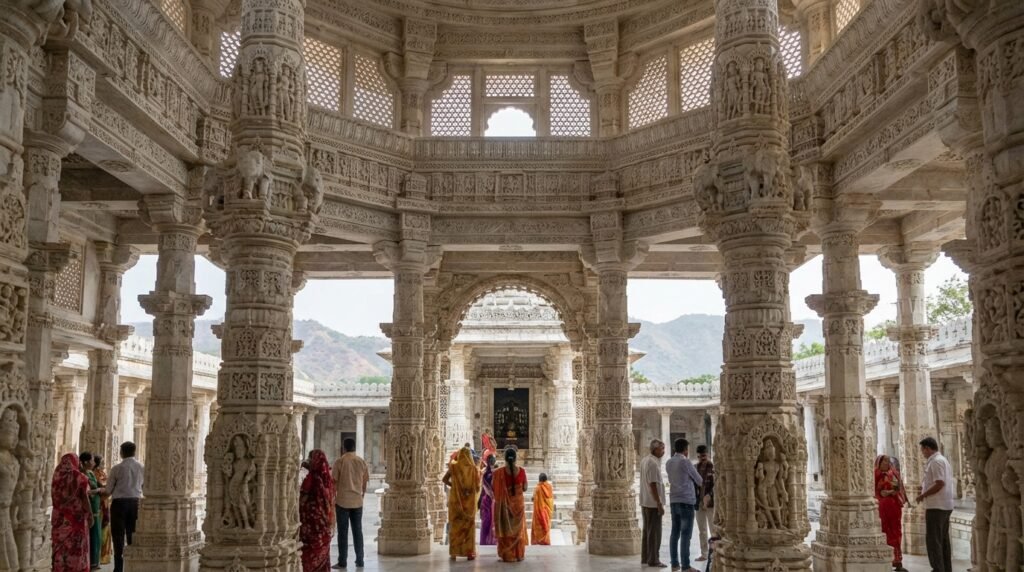
Tradition: Svetambara | Best Time: October-March
An architectural miracle—the Chaumukha (four-faced) Adinath Temple with 1,444 intricately carved pillars, no two alike! Built in 1439 CE using white Makrana marble, this temple represents the pinnacle of Jain temple architecture.
Architectural Marvels:
- Each of 1,444 pillars has unique carvings
- Light filtering through creates ever-changing patterns
- 29 halls, 80 domes, 400 columns
- Four-faced idol facing four cardinal directions
- Intricate ceiling with geometric patterns
Complex Includes:
- Chaumukha Temple (main)
- Parsavanatha Temple
- Amba Mata Temple (Hindu)
- Surya Narayan Temple (Hindu)
Duration: 2-3 hours
Timings: 12:00 PM to 5:00 PM (closed mornings for prayers)
Entry: Free (camera ₹100)
Location: Between Udaipur (90 km) and Jodhpur (165 km), Pali District
TravelPaa Tip: Visit just after noon opening for peaceful darshan. Photography allowed in certain areas. Combine with Udaipur/Mount Abu trip.
3. Dilwara Temples, Mount Abu, Rajasthan
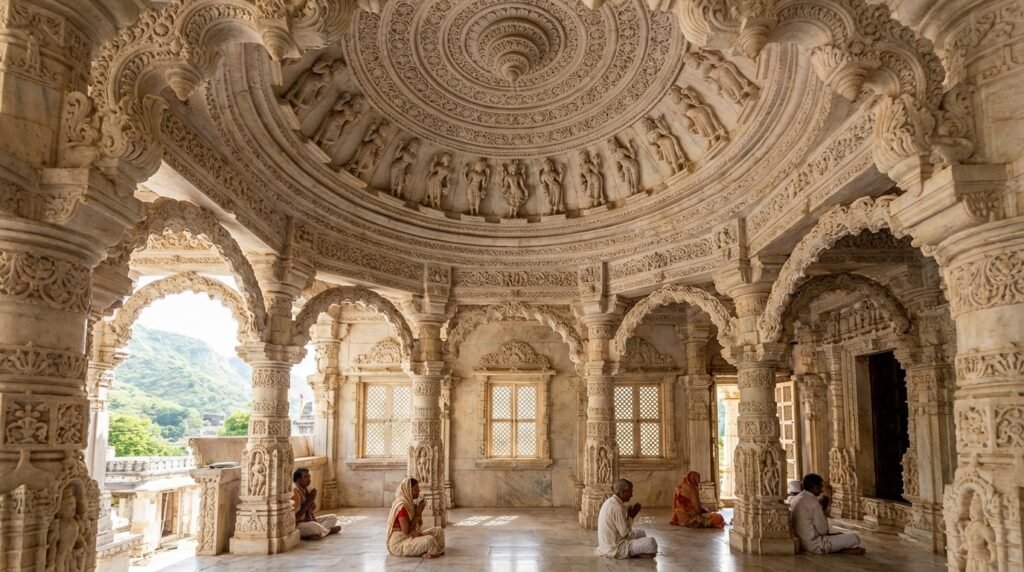
Tradition: Svetambara | Best Time: March-June, September-December
The finest example of marble temple architecture in India—five temples built between 11th-13th centuries showcasing mind-boggling intricate carvings that defy belief in their delicacy and detail.
Five Temples:
- Vimal Vasahi (1031 CE)—dedicated to 1st Tirthankara Adinath
- Luna Vasahi (1230 CE)—dedicated to 22nd Tirthankara Neminath
- Pithalhar Temple—dedicated to Adinath
- Khartar Vasahi—dedicated to Adinath
- Mahavir Swami Temple—dedicated to Mahavir
Highlights:
- Marble ceilings resembling lace—unbelievable craftsmanship
- Every inch carved with deities, flowers, geometric patterns
- Dome in Luna Vasahi with concentric circles of carved figures
- Marble so finely carved it appears translucent
Duration: 2 hours
Timings: 12:00 PM to 6:00 PM (closed mornings)
Entry: Free
Location: Mount Abu (2.5 km from town), Rajasthan
TravelPaa Tip: Photography strictly prohibited inside. Visit in afternoon when temples open. Hill station setting offers pleasant weather year-round.
4. Shravanabelagola, Karnataka
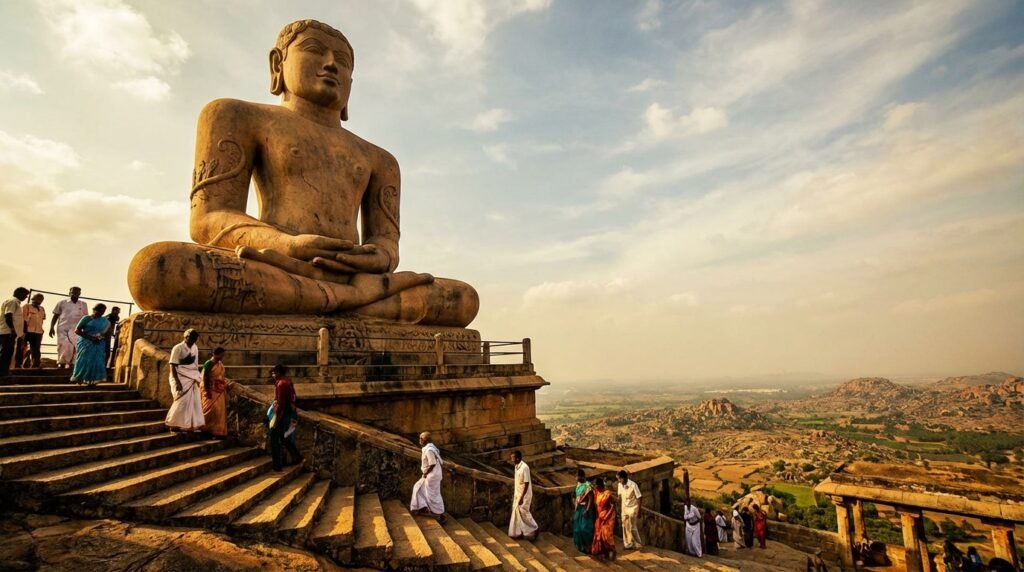
Tradition: Digambara | Best Time: October-March
Home to the 57-foot tall monolithic statue of Lord Bahubali (Gomateshwara)—India’s tallest monolithic statue carved from a single granite block in 983 CE, standing majestically atop Vindhyagiri Hill.
Significance:
- Lord Bahubali (son of first Tirthankara) meditated here for one year
- Every 12 years: Mahamastakabhisheka—grand anointment ceremony where statue is bathed with milk, saffron, turmeric, sandalwood (next: 2030)
- Over 1,000-year-old statue still pristine
Experience:
- Climb 700 stone steps barefoot to reach statue
- Panoramic views of Karnataka plains
- 14 Jain temples atop Chandragiri Hill (opposite hill)
- Peaceful, spiritually charged atmosphere
Duration: Half day
Timings: 6:30 AM to 11:30 AM, 3:30 PM to 6:30 PM
Entry: Free
Location: Hassan District, Karnataka (85 km from Hassan, 145 km from Bangalore)
TravelPaa Tip: Visit early morning to avoid heat. Mahamastakabhisheka in 2030 attracts millions—book accommodation months in advance.
5. Sammed Shikharji (Parasnath Hill), Jharkhand
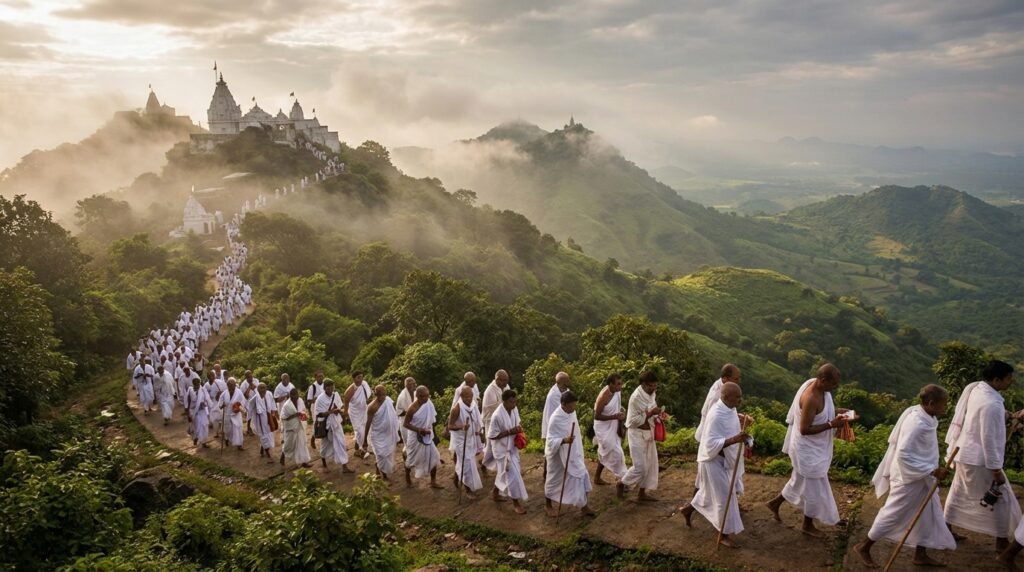
Tradition: Both Digambara & Svetambara | Best Time: October-March
The holiest Jain tirtha—where 20 out of 24 Tirthankaras attained nirvana (moksha). Sammed Shikharji is considered more sacred than any other Jain site because of this unparalleled spiritual significance.
Pilgrimage:
- 27 km trek covering 20+ temple shrines on hilltops
- Can be completed in 1-2 days (palanquins available)
- Each shrine marks where a Tirthankara attained nirvana
- Parasnath Hill—highest peak in Jharkhand (4,477 feet)
Sacred Spots:
- Jal Mandir (Water Temple)
- Panchpahad (five hills)
- 20 Tonks (temple shrines)
Duration: 2-3 days (including trek)
Best Season: Winter (avoid monsoons)
Location: Giridih District, Jharkhand (near Madhuban base town)
TravelPaa Package: Sammed Shikharji Yatra (3N/4D) from ₹14,999 per person—includes accommodation, meals, palanquin option, guide.
6. Girnar Hill, Junagadh, Gujarat
Tradition: Both | Best Time: November-February
Sacred hill with 3,000+ Jain temples scattered across the slopes, requiring a climb of 10,000 steps—one of India’s most challenging pilgrimages. Five prominent Jain temples on the hilltops.
Major Temples:
- Neminath Temple (22nd Tirthankara)—main shrine
- Mallinath Temple (19th Tirthankara)
- Triple temple complex
- Ancient temples dating to 12th century
Challenge: 10,000 steps (6-8 hours round trip)—ropeway available for first 4,000 steps
Duration: Full day
Location: Junagadh, Gujarat (near Somnath, 85 km)
7. Sonagiri, Madhya Pradesh
Tradition: Digambara | Best Time: October-March
77 Jain temples spread across hilltop, accessed by 300 steps. Known for Sallekhana (ritual fast unto death)—many Jain monks have attained nirvana here through voluntary fasting.
Significance: Center for Digambara Jain learning and meditation
Duration: Half day
Location: Datia District, near Gwalior, Madhya Pradesh
8. Pawapuri, Bihar
Tradition: Both | Best Time: October-March
The sacred site where Lord Mahavir (24th Tirthankara) attained nirvana in 527 BCE. The Jal Mandir (Water Temple) stands in the middle of a lotus pond marking the exact cremation spot.
Significance:
- Mahavir’s final nirvana site
- Beautiful Jal Mandir in lotus pond
- Peaceful, spiritually powerful
Duration: 2-3 hours
Location: Nalanda District, Bihar (90 km from Patna)
Combine: With Rajgir, Nalanda Buddhist sites
9. Kundalpur, Bihar
Tradition: Digambara | Best Time: October-March
Birthplace of Lord Mahavir—the most important Jain site for Digambara Jains. Modern temple complex with impressive architecture.
Highlights:
- Birth site of 24th Tirthankara
- Modern temples with ancient significance
- Peaceful pilgrimage atmosphere
Duration: 2-3 hours
Location: Nalanda District, Bihar
10. Taranga Hill, Gujarat
Tradition: Svetambara | Best Time: November-February
Cluster of Jain temples atop Taranga Hill, including the famous Ajitanath Temple (2nd Tirthankara). Ancient temples with beautiful carvings.
Duration: Half day
Location: Mehsana District, Gujarat
11. Muktagiri, Maharashtra
Tradition: Digambara | Best Time: October-March
52 Jain temples spread across hilltop. A significant Digambara pilgrimage center with ancient temples and peaceful atmosphere.
Trek: Moderate climb to hilltop temples
Duration: Half day
Location: Betul District, Madhya Pradesh (near Maharashtra border)
12. Samet Shikhar (Parsvanatha Temple), Bihar
Tradition: Digambara | Best Time: October-March
Important Digambara temple complex near Sammed Shikharji, dedicated to 23rd Tirthankara Parshvanatha.
Duration: 1-2 hours
Location: Near Madhuban, Jharkhand
13. Anwa (Anupgarh), Rajasthan
Tradition: Digambara | Best Time: October-March
Ancient Jain pilgrimage site with historical temples. Known for Digambara Jain community gatherings.
Duration: Half day
Location: Sri Ganganagar District, Rajasthan
14. Gajpantha (Pavagadh), Gujarat
Tradition: Svetambara | Best Time: November-February
Jain temples on Pavagadh Hill (UNESCO World Heritage Site)—combine with Champaner heritage site visit. Ancient Jain shrines amid archaeological wonders.
Duration: Half day
Location: Panchmahal District, Gujarat (near Vadodara)
15. Chandragiri Hill, Karnataka
Tradition: Digambara | Best Time: October-March
Opposite hill to Vindhyagiri at Shravanabelagola, hosting 14 Jain temples including Chandragupta Basadi dedicated to Emperor Chandragupta Maurya who became a Jain monk.
Significance: Emperor Chandragupta spent his final days here
Duration: Combine with Shravanabelagola visit
Location: Shravanabelagola, Karnataka
16. Moodbidri (Saavira Kambada Basadi), Karnataka
Tradition: Digambara | Best Time: October-March
Known as “Jain Kashi of the South”—18 Jain temples, most famous being Saavira Kambada Basadi (Thousand Pillar Temple) built in 1430 CE.
Highlights:
- 1,000 intricately carved pillars
- Ancient Jain manuscripts library
- Hub of Jain learning
Duration: Half day
Location: Dakshina Kannada District, Karnataka
17. Karkala, Karnataka
Tradition: Digambara | Best Time: October-March
42-foot monolithic statue of Lord Bahubali (Gomateshwara) carved in 1432 CE—second only to Shravanabelagola in size. Beautiful hilltop setting.
Duration: 2-3 hours
Location: Udupi District, Karnataka
18. Venur (Venoor), Karnataka
Tradition: Digambara | Best Time: October-March
35-foot monolithic statue of Lord Bahubali, along with ancient Jain temples and Venkataramana Temple.
Duration: 2 hours
Location: Dakshina Kannada District, Karnataka
19. Lal Mandir (Red Temple), Delhi
Tradition: Digambara | Best Time: Year-round
Oldest Jain temple in Delhi (1656 CE) opposite Red Fort. Famous for its bird hospital treating injured birds—embodiment of Jain ahimsa.
Highlights:
- Ancient temple in Old Delhi
- Charity Bird Hospital
- Easy access for travelers
Duration: 1-2 hours
Location: Chandni Chowk, Old Delhi
20. Kulpakji Temple, Telangana
Tradition: Digambara | Best Time: October-March
Ancient Jain temple with unique architecture, dedicated to Rishabhanatha. Important pilgrimage site in South India.
Duration: Half day
Location: Kolanpak Village, near Hyderabad, Telangana
21. Jal Mandir, Pawapuri, Bihar
Tradition: Both | Best Time: October-March
(Covered in #8 but expanded here)
The stunning Water Temple built in the middle of a lotus pond, marking the exact spot where Lord Mahavir was cremated. One of the most photographed Jain temples.
Experience:
- Marble temple in lotus pond
- Serene water setting
- Peaceful meditation spot
- Important for Mahavir Nirvana Divas (October)
Duration: 1-2 hours
Location: Pawapuri, Bihar
Sample Jain Pilgrimage Itineraries
Gujarat Jain Circuit (7D/6N)
Route: Ahmedabad → Palitana (2N) → Girnar (1N) → Taranga → Ranakpur (2N) → Mount Abu Dilwara (1N)
Covers: Svetambara holy sites
Cost: ₹19,999 per person
Karnataka Jain Heritage Trail (5D/4N)
Route: Bangalore → Shravanabelagola (1N) → Moodbidri (1N) → Karkala & Venur (1N) → Bangalore
Covers: Digambara monolithic statues
Cost: ₹15,999 per person
Jharkhand-Bihar Spiritual Circuit (6D/5N)
Route: Patna → Kundalpur → Pawapuri → Sammed Shikharji (3N) → Patna
Covers: Mahavir sites + holiest tirtha
Cost: ₹14,999 per person
Rajasthan Marble Marvels (6D/5N)
Route: Jaipur → Ranakpur (2N) → Mount Abu Dilwara (2N) → Udaipur (1N)
Covers: Finest marble architecture
Cost: ₹18,999 per person
Essential Jain Pilgrimage Tips
Dietary Requirements:
- Strictly vegetarian—no root vegetables at many sites (onion, garlic, potato)
- Pure Jain food (no root vegetables) available near major tirthas
- TravelPaa arranges Jain-compliant meals
Dress Code:
- Modest clothing—cover shoulders, knees
- White clothing preferred for pilgrimages
- Remove footwear, leather items before entering temples
Physical Preparation:
- Train for climbs: Palitana (3,800 steps), Girnar (10,000 steps), Sammed Shikharji (27 km trek)
- Palanquin services available but expensive
- Start early to avoid midday heat
Rituals & Customs:
- Pradakshina: Circumambulate clockwise
- Offerings: Flowers, rice, sweets (no animal products)
- Photography: Often restricted inside sanctums—ask permission
Best Time: October-March (winter)—comfortable for temple visits and climbs
Why Choose TravelPaa for Your Jain Pilgrimage?
At TravelPaa, the best travel agency in Delhi, we specialize in Jain pilgrimages with deep understanding of Jain dietary requirements, temple protocols, and spiritual significance.
Our Jain Pilgrimage Expertise:
✅ Pure Jain Meals: Strictly vegetarian, no root vegetables, freshly prepared
✅ Temple Timings: Scheduled around prayer times and darshan hours
✅ Physical Support: Palanquin arrangements, pace suitable for all ages
✅ Knowledgeable Guides: Understand Jain philosophy, rituals, history
✅ Spiritual Atmosphere: Fellow Jain travelers, respectful environments
✅ Complete Packages: Accommodation, transport, meals, entry fees, guides—all arranged
TravelPaa Jain Pilgrimage Packages 2026
| Package | Duration | Destinations | Price |
| Gujarat Jain Circuit | 7D/6N | Palitana-Girnar-Ranakpur-Dilwara | ₹29,999 |
| Karnataka Jain Heritage | 5D/4N | Shravanabelagola-Moodbidri-Karkala | ₹25,999 |
| Sammed Shikharji Yatra | 6D/5N | Kundalpur-Pawapuri-Sammed Shikharji | ₹24,999 |
| Rajasthan Marble Marvels | 6D/5N | Ranakpur-Dilwara-Udaipur | ₹28,999 |
| Complete Jain Pilgrimage | 14D/13N | Gujarat-Rajasthan-Jharkhand-Bihar | ₹72,999 |
Includes: Pure Jain meals, accommodation, transport, guide, temple entry, palanquin option (where needed)
🎁 Special Offers – Mahavir Jayanti 2026
Book by March 31, 2026:
- 12% OFF all Jain pilgrimage packages
- Free palanquin service at Palitana (worth ₹3,000)
- Complimentary Jain prayer book for each traveler
Group Benefits (8+ pilgrims):
- Additional 10% discount
- Free tour coordinator for groups of 15+
Quote Code: “JAINPILGRIMAGE2026”
📞 Contact TravelPaa – Begin Your Sacred Jain Journey
Email: holidays@travelpaa.com
Phone/WhatsApp: +91-98999-21559
Website: www.travelpaa.com
Address: 13, 3rd Floor, Vaishali Enclave, Pitampura, Delhi, 110034
Final Thoughts: Path to Spiritual Elevation
Priyanka, whose Palitana journey opened this guide, has since completed pilgrimages to Shravanabelagola and Ranakpur. “Each Jain tirtha taught me something profound,” she reflects. “Palitana taught perseverance, Shravanabelagola taught humility before monumental devotion, Ranakpur taught appreciation for human craftsmanship dedicated to the divine. Jain pilgrimages aren’t just about visiting temples—they’re about embodying the principles each site represents.”
India’s Jain temples and tirthas offer more than architectural beauty. They offer transformation through physical challenge, spiritual elevation through sacred spaces, and cultural immersion into one of the world’s most ancient wisdom traditions.
From Palitana’s marble-clad hills to Shravanabelagola’s towering monolith, from Ranakpur’s incomparable pillars to Sammed Shikharji’s supreme sanctity—each site awaits with blessings, beauty, and profound peace.
At TravelPaa, we’re honored to facilitate your Jain pilgrimage with the reverence, authenticity, and care it deserves. Let us handle logistics while you focus on spiritual experience.
Your path to enlightenment begins with a single step. Let that step be with TravelPaa.
🙏 Jai Jinendra! May Your Pilgrimage Be Blessed!
🕉️Disclaimer: Temple timings, darshan policies, and palanquin costs are subject to change based on temple authorities’ decisions and seasonal variations. Prices mentioned are approximate starting costs. Please contact TravelPaa for current, accurate information and customized quotations.